Data & Metadata Export
Export of Entities in Lab Notebooks & Inventory Spaces
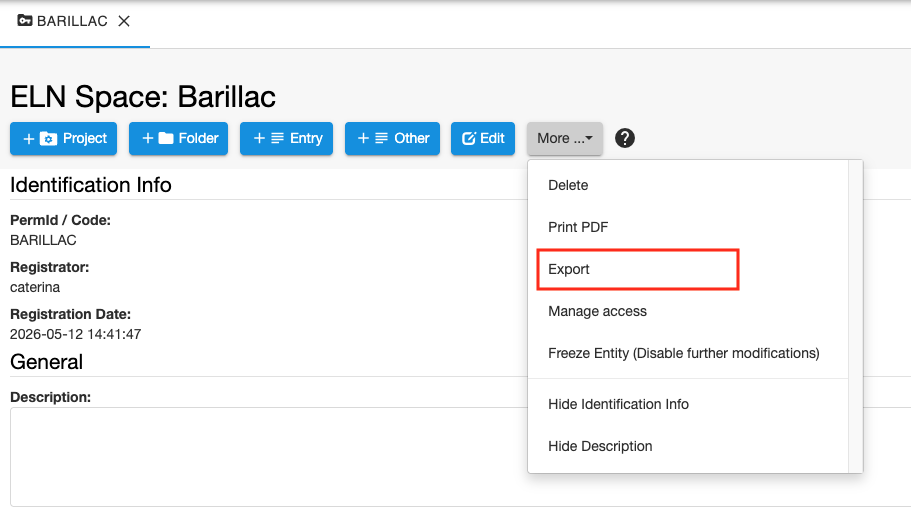
All levels of the Lab Notebook and Inventory can be exported, using the Export option in the More.. drop down, as shown below for a Space.
In each case, the following export options are available:
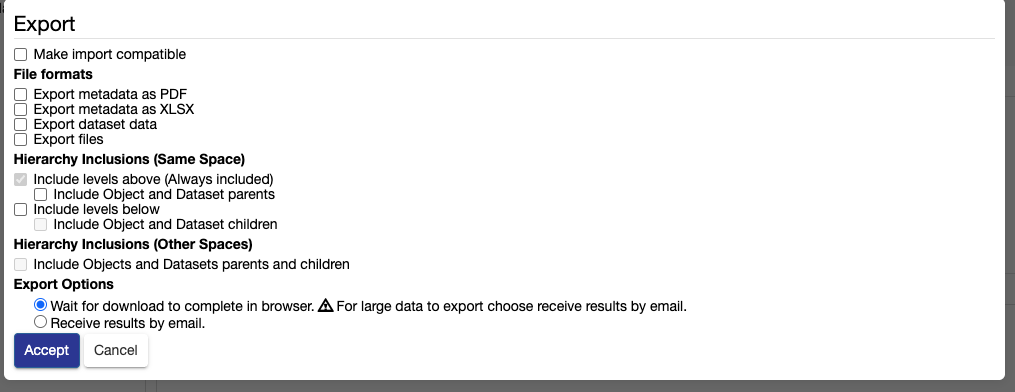
Make import compatible. If selected, datasets are exported in a data folder and are in a format ready to be uploaded in openBIS using the default eln-lims dropbox; the metadata are exported in a xlsx folder which contains information in a format ready to be uploaded via the openBIS admin UI.
File formats
Export metadata as PDF. Metadata are exported in a hierarchy folder that keeps the folder structure of the ELN. At each level, one pdf file for each exported entity is generated.
Export metadata as XLSX. Metadata are exported in one xlsx folder. The folder contains the metadata of all exported entities and the corresponding masterdata in a metadata.xlsx file. If Make import compatible is selected, this file is suitable for re-import in openBIS. If not, the file contains some fields which are not compatible with re-imports. These fields are: PermId of entities, registrator, registration date, modifier, modification date. In addition to the metadata.xlsx file, the xlsx folder might contain additional folders:
a scripts folder, which contains scripts associated with types in the metadata.xlsx file, if these are present;
a data folder which holds the content of large text fields that exceed the size of an Excel cell;
a miscellaneous folder which contain images embedded in text of exported entries, if present.
Export dataset data. The default maximum size of all datasets to be exported is 10GB. This can be configured by a system admin in the AS service.properties file. We recommend to use sftp to download large datasets. Alternatively it is also possible to use PyBIS or the obis command line. If Make import compatible is selected, datasets are exported in a data folder in a format ready to be uploaded in openBIS using the default eln-lims dropbox. If not, the datasets are exported in a hiearchy folder that matches the ELN hierarchy.
Export files. This refers to files directly attached to entities (in AFS), not as openBIS datasets. The files are contained in the corresponding entity folders in hierarchy.
Hierarchy inclusions (Same Space)
Include levels above (Always included). Thi referrs to the fact that if you select a level below Space (see openBIS data model), all levels above will be exported. For example, if you export Object A, which belongs to Collection A, Project A, Space A, the export will contain Space A/ Project A/ Collection A/ Object A.
Include Objects and Dataset parents. If you export one Object or Dataset that has parents in the same Space, also in different Projects/Collections, these parents will be exported.
Include levels below. If selected, all hierachy levels below the selected entity and belonging to the same Space are exported.
Include Objects and Dataset children. If you select this option, all Objects and Dataset children of the Object/Dataset you want to export will also be exported.
Hierarchy inclusions (Other Space)
Include Objects and Datasets parents and children. This allows to export Objects and Datasets parents and children that belong to a different Space than the Space from where Objects and Datasets are being exported. Example: I export Object A in Space 1, which has parents in Space 2. If this option is selected, the parents in Space 2 are also exported, otherwise they are not.
Export options
Wait for download to complete in browser. This is suitable when exporting only metadata or small datasets. When the dowload is ready, a zip file will be available to download from the browser.
Note: ensure that pop-ups are not disabled in your browser.
Receive results by email. If this option is selected, when the export is ready, you will receive an email notification with a download link. Email notification needs to be configured on system level during or after installation, as explained in Configure Data Store Server
Examples
We provide below a couple of examples of the export, to clarify how it works.
1. Import-compatible export of a Space selecting all options
We select all options from the export widget, as shown below.
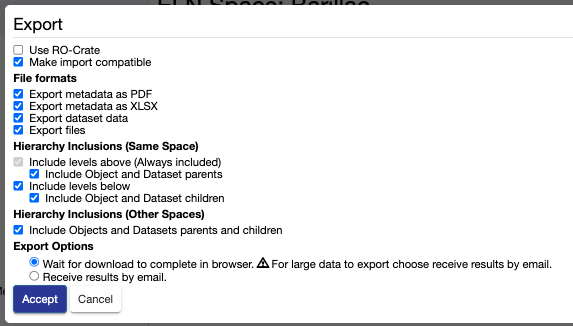
We export a Space called BARILLAC in the Lab Notebook with all its sublevels (see below).
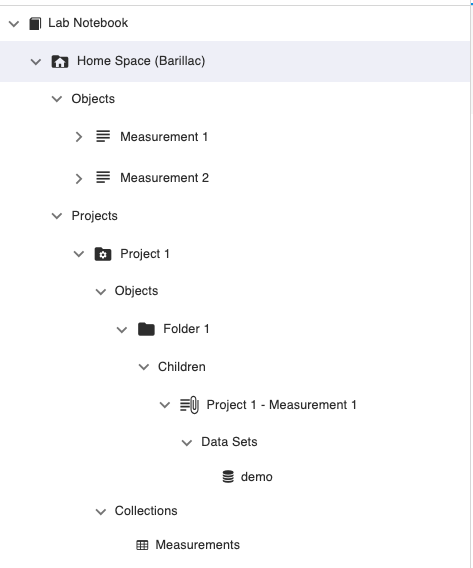
One Object in this Space has a protocol as parent, and this is in the METHODS Space.
The exported zip file contains 3 folders:
A. data folder
This contains the datasets in the correct format to be uploaded via eln-lims dropbox, as shown below.

B. hiearchy folder
This contains folders that match the openBIS hierarchy (Space, Project, Experiment/Collection, Object).
In this case 2 Space folders are present:
BARILLAC: is the exported space. One of the entities in this space contains AFS data, which are exported in a data folder inside the entity they belong to.

MATERIALS: contains a sample which is parent of a measurement in the Space BARILLAC. This was exported because we selected the option to Include Objects and Datasets parents and children from other spaces.

Inside each folder, there is a pdf of the corresponding entity. Example:
in the Space folder BARILLAC there is a BARILLAC.pdf file that contains the metadata of the Space;
in the Measurement 1 (ENTRY1) folder there is a Measurement 1 (ENTRY1).pdf file that contains the metadata of this Object;
in the Project folder PROJECT_1 there is a PROJECT_1.pdf file that contains the metadata of the Project;
C. xlsx folder.

This contains:
a metadata.xlsx file which has the metadata of the exported entities and the corresponding masterdata (types and properties) in the correct format to be re-imported in another openBIS instance;
a scripts folder that contains evaluation plugins associated to two types defined in the metadata.xlsx file. This folder is present only if the exported types have plugins associated with them.
a miscellaneous folder that contains images that are embedded in text fields of the exported entities. This folder is present only if exported entities contain images embedded in text.
If the entities you are exporting contain very large txt with more than 32,767 characters (Excel limit for cell size), these are exported separately to a data folder inside the xlsx folder.
2. Non import-compatible export of a Space selecting all options
We export the same Space as described in Example 1, with all options selected, but the export this time is not import-compatible, as shown below.
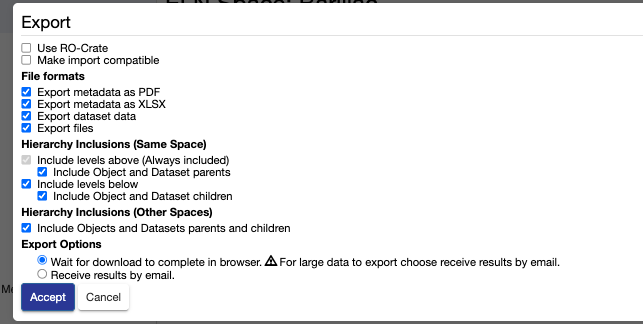
In this case the exported .zip file contains only 2 folders: hierarchy and xlsx. Data are exported inside the hierachy folder, instead of being in a separate data folder.
A. hierarchy folder
This contains the same folder structure as described above. In addition, in this case, if an Object or an Experiment/Collection contains a dataset, this is exported in a data folder inside the entity it belongs to.

B. xlsx folder
This contains the same files and folders as described in Example 1. The only difference in this case is that the metadata.xlsx is not import-compatible. It contains some fields which are not compatible with openBIS re-import, as explained above.

Export to ZIP
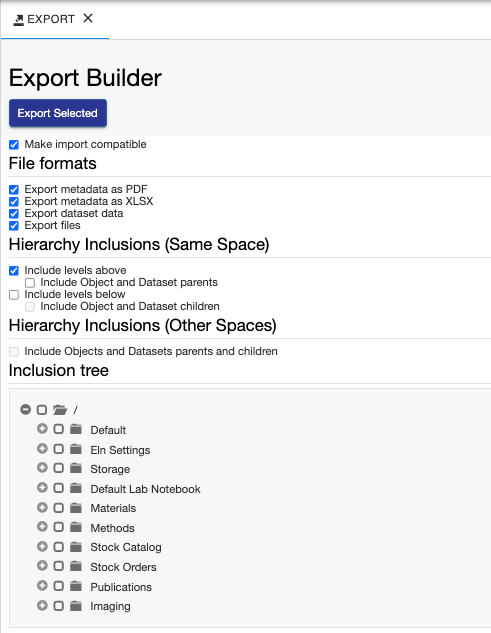
If you want to export entities from multiple Spaces, you can use the Export to ZIP option available under the Tools section.
The options for the export are similar to what is described above. However, in this case, only the option to receive the export via email is available. When export is ready, you will receive an email with a link to download the zip file containing the exported entities.